Role of Artificial Intelligence in Microsoft Dynamics 365 F&O
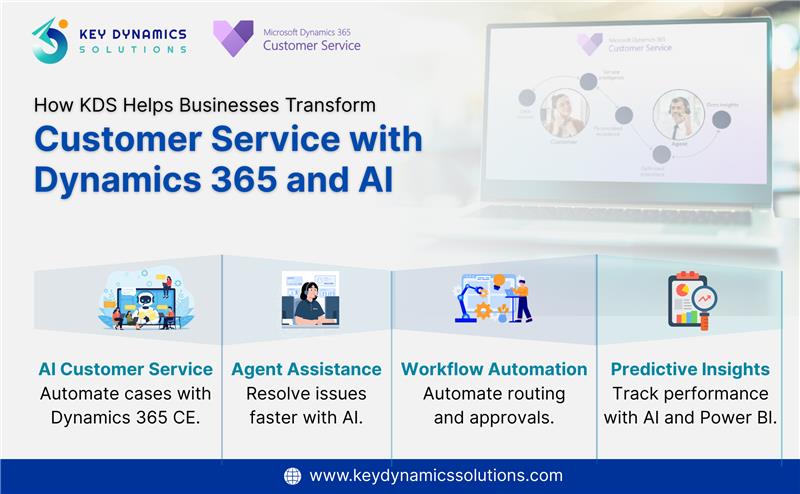
Artificial Intelligence (AI) is transforming get more info how modern enterprises manage finance, operations, and supply chains. Organizations today require systems that not only record transactions but also provide predictive insights, automate processes, and support smarter decision-making. This is where Microsoft Dynamics 365 Finance & Operations (F&O) stands out. By embedding AI into core enterprise resource planning (ERP) capabilities, Dynamics 365 enables businesses to operate with greater agility, efficiency, and accuracy.
At Key Dynamics Solutions, we help organizations unlock the full value of AI within Dynamics 365 to drive measurable business outcomes.
AI as a Strategic Enabler in Dynamics 365
AI within Microsoft Dynamics 365 is not an add-on feature—it is deeply integrated into workflows across finance, supply chain, manufacturing, and operations. Through machine learning models, predictive analytics, and intelligent automation, businesses can move from reactive decision-making to proactive strategy.
For example, AI algorithms analyze historical and real-time data to forecast demand fluctuations, identify financial risks, and optimize inventory planning. Instead of relying on spreadsheets or manual analysis, decision-makers receive actionable insights directly within the D365 environment.
Intelligent Financial Management
One of the most impactful areas of AI in Dynamics 365 F&O is financial management. AI enhances processes such as cash flow forecasting, expense monitoring, and anomaly detection.
AI-driven financial insights help organizations:
Predict cash shortages before they occur
Detect unusual transactions that may indicate fraud or errors
Automate invoice processing and reconciliation
Improve budgeting accuracy with predictive models
This level of intelligence allows finance teams to focus on strategy rather than routine data entry.
Supply Chain Optimization with AI
Supply chain disruptions can significantly affect business performance. AI within Dynamics 365 helps organizations anticipate challenges and respond quickly.
Key AI-powered supply chain capabilities include:
Demand forecasting using historical trends and market signals
Inventory optimization to reduce carrying costs
Supplier risk analysis and performance evaluation
Predictive maintenance for equipment and assets
By leveraging AI, organizations can maintain optimal stock levels, avoid delays, and improve customer satisfaction.
Automation and Productivity Gains
Automation is another major advantage of AI integration in D365. Routine tasks such as order processing, procurement approvals, and reporting can be automated using intelligent workflows.
Benefits of AI-driven automation include:
Reduced manual errors
Faster processing times
Increased employee productivity
Lower operational costs
Employees can then focus on higher-value activities like innovation, planning, and customer engagement.
Data-Driven Decision Making
Modern enterprises generate enormous amounts of data. Without AI, extracting meaningful insights from this data can be overwhelming. Dynamics 365 uses AI to convert raw data into clear, actionable intelligence.
Advanced analytics dashboards provide leadership teams with real-time visibility into financial health, operational efficiency, and performance metrics. Predictive insights help organizations prepare for future scenarios rather than reacting after problems occur.
AI and User Experience in D365
AI also improves the user experience within Microsoft Dynamics 365. Intelligent recommendations guide users toward the best actions, whether approving a purchase order or adjusting inventory levels.
Conversational AI tools and digital assistants further simplify system interactions by enabling users to retrieve information or perform tasks using natural language commands. This reduces training time and increases user adoption across departments.
The Future of AI in Dynamics 365
The role of AI in Dynamics 365 will continue to expand as technologies evolve. Future advancements are expected to include:
More autonomous decision-making capabilities
Deeper integration with generative AI tools
Enhanced predictive modeling accuracy
Industry-specific AI solutions
Organizations that adopt AI early will gain a competitive advantage through improved efficiency, agility, and innovation.
How Key Dynamics Solutions Supports AI Adoption
Implementing AI within Dynamics 365 requires both technical expertise and business understanding. At Key Dynamics Solutions, we guide organizations through every stage of AI adoption—from strategy and implementation to optimization and support.
Our approach focuses on aligning AI capabilities with business goals to ensure measurable ROI and long-term success.
Conclusion
Artificial Intelligence is redefining enterprise resource planning, and Microsoft Dynamics 365 F&O is at the forefront of this transformation. By integrating AI into finance, operations, and supply chain processes, businesses can achieve smarter automation, predictive insights, and improved decision-making.
Organizations that leverage AI within D365 today are positioning themselves for sustainable growth and future innovation.
Frequently Asked Questions(FAQs)
1. How does AI improve operations in Dynamics 365 Finance & Operations?
AI helps automate routine tasks, predict demand, and provide real-time insights, allowing businesses to make faster and more accurate decisions.
2. Can AI reduce manual work in finance processes?
Yes, AI handles repetitive tasks like invoice processing, data entry, and reconciliation, saving time and reducing human errors.
3. How does AI support supply chain management in Dynamics 365 F&O?
AI analyzes historical data to forecast demand, optimize inventory levels, and prevent supply chain disruptions.
4. Is AI in Dynamics 365 F&O useful for decision-making?
Absolutely. AI delivers predictive analytics and actionable insights, helping managers plan budgets, reduce risks, and improve performance.
5. Does AI enhance customer and vendor management?
Yes, AI provides better insights into customer behavior and vendor performance, helping businesses build stronger relationships and improve service quality.